


Smooth Roads and Unimpeded Cargo Flow: Hekou Port Economy in Yunnan Presses the "Accelerator"
Vehicles loaded with goods queue up in the freight passage, while entry-exit personnel pass through the passenger passage. Trains loaded with goods travel back and forth between China and Vietnam through the railway port... According to the government of Hekou County, Honghe Hani and Yi Autonomous Prefecture, Yunnan Province, the local port economy has been accelerating in recent years, and the county's economic development has continuously made new breakthroughs.
Hekou Port is the largest land port on the Yunnan section of the China-Vietnam border, facing Lao Cai District of Lao Cai Province, Vietnam across the river. Hekou Port features the Nanxi River Passenger Transport Corridor, a highway port for personnel entry and exit, as well as the Honghe Freight Transport Corridor and Shanyao International Railway Port, which are highway ports for cargo entry and exit. According to statistics from the Hekou County Port Office, in the first 11 months of 2025, the import and export volume of goods at Hekou Port exceeded 4.03 million tons, with a value exceeding 18.4 billion yuan, and the volume of goods increased by more than 13% year-on-year. As of December 12, 2025, the number of people entering and exiting the country since 2025 has exceeded 6 million, a 5.8-fold increase compared to 2020.
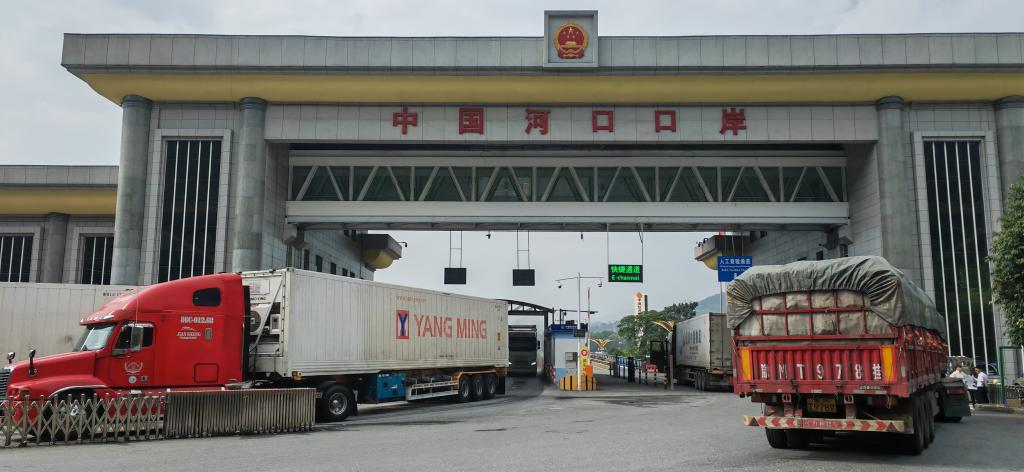
Two trucks are passing through the Honghe freight corridor. Photographed by Pu Chao, a reporter from Xinhua News Agency
Recently, reporters observed at the freight yard of the Honghe freight corridor that hundreds of vehicles loaded with goods were parked there. Judging from the license plates, the trucks came from multiple provinces such as Sichuan, Hubei, Anhui, and Shandong. After passing through the border inspection in turn, the trucks crossed the Honghe Highway Bridge and entered Vietnam. The staff at the Hekou Exit-Entry Frontier Inspection Station carefully inspected each truck. They operated with remote controls in hand, and robots shuttled under the trucks, transmitting clear images to the display screen.
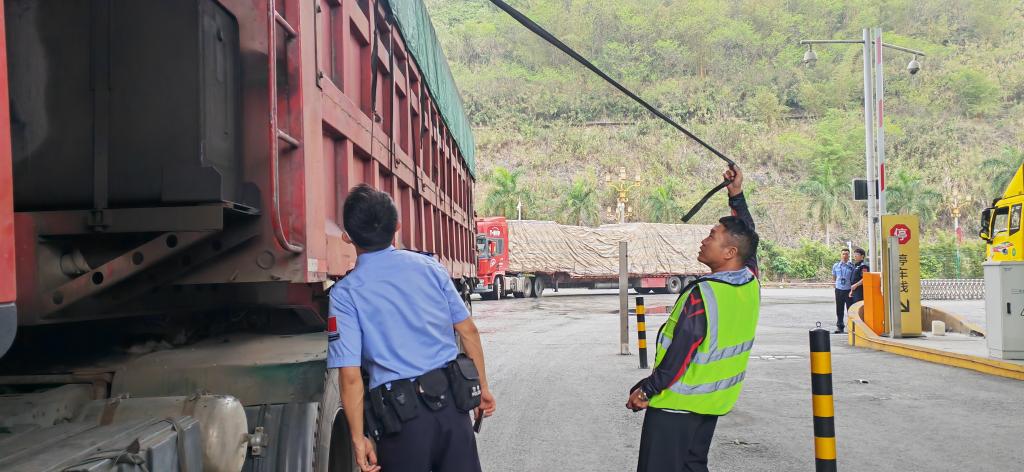
The police at the Hekou Exit-Entry Frontier Inspection Station are carefully inspecting the truck. Photographed by Pu Chao, reporter of Xinhua News Agency
A fully loaded truck with Shandong license plates is undergoing inspection. The driver said he frequently travels between China and Vietnam, mainly transporting agricultural products, fertilizers, and other goods. "Nowadays, online customs declaration is convenient, the procedures are complete, and the inspection is efficient. It takes less than 10 minutes to complete the inspection," the driver said.
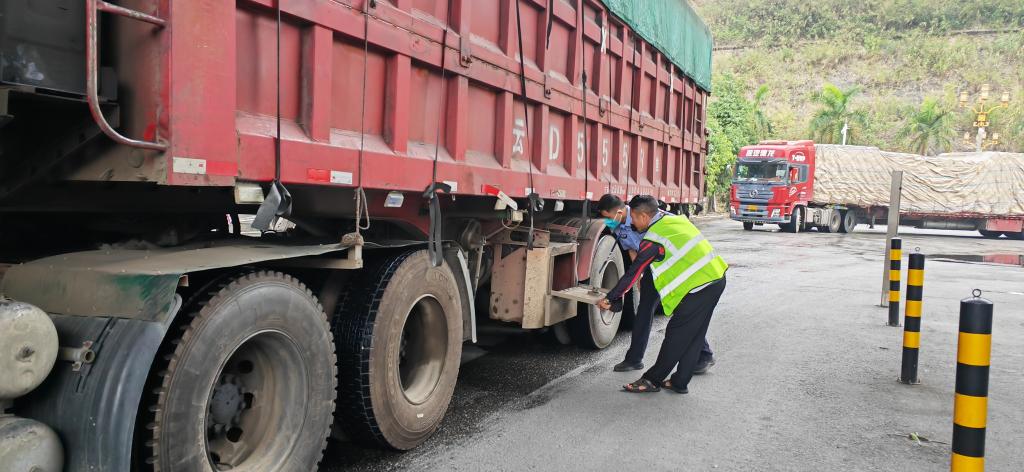
The police at the Hekou Exit-Entry Frontier Inspection Station are carefully inspecting the truck. Photographed by Pu Chao, a reporter from Xinhua News Agency
"Customs clearance has undergone a transformation and upgrading from 'rummaging through containers' to 'intelligent machine inspection'." According to the staff of Hekou County Port Office, the Honghe freight corridor has established systems such as joint intelligent inspection and release checkpoints, electronic license plate intelligent inspection and release, and Chinese driver record management. By combining methods such as "multi-card integration and direct access upon arrival", the pre-declaration process has been optimized, and customs clearance time has been reduced from 30 minutes in the past to less than 10 minutes, effectively improving the business environment and promoting the development of foreign trade.
In the early morning, at the international railway port on the mountainside, the sound of a train's whistle pierces the sky. A freight train loaded with coke speeds along the tracks towards Vietnam. In the first 11 months of 2025, this railway port handled 280,000 tons of import and export goods, with a value of 560 million yuan.
At 8 a.m. at the joint inspection building of the Nanxi River passenger transport corridor, as soon as the gate opens, many Vietnamese people rush towards the river mouth at the speed of a hundred-meter sprint, forming a unique scenery. Most of them are Vietnamese border residents who come to the river mouth for work or to purchase daily necessities.
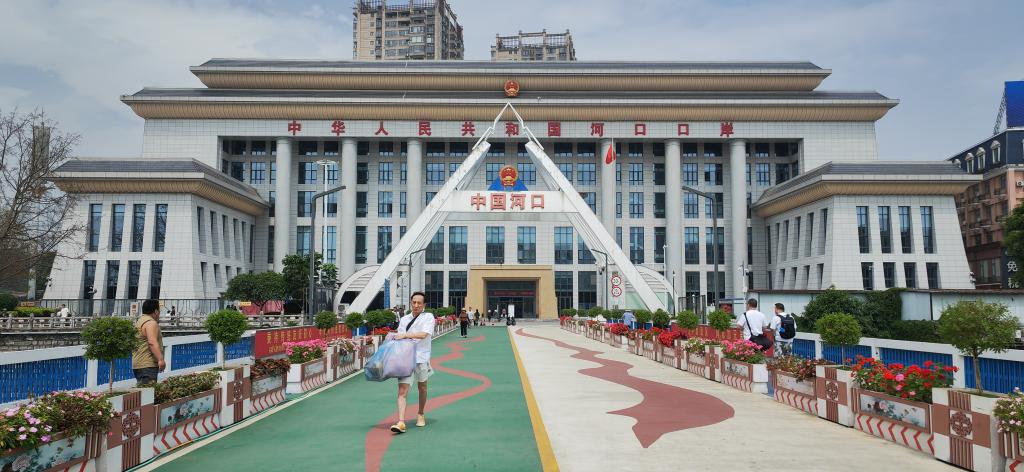
Joint Inspection Building of Nanxi River Passenger Transport Corridor. Photographed by Pu Chao, reporter of Xinhua News Agency
Among the inbound crowd, there are also many tourists. The staff at the Hekou Exit-Entry Frontier Inspection Station said that with the implementation of a series of policies facilitating foreigners' visits to China and the continuous expansion of the visa-free "circle of friends", choosing to enter China through Hekou Port to start their "China tour" has become popular among many foreign tourists, especially Vietnamese tourists. The passenger flow at Hekou Port has continued to rise, with an average of about 15,000 inbound and outbound passengers per day since 2025, and over 20,000 during peak holiday periods.
Chen Shaozong, Deputy Director of the Border Inspection Division at Hekou Exit-Entry Frontier Inspection Station, said, "To enhance the efficiency of passenger flow, the port has deployed a visual command and control platform for duty operations, which provides real-time early warning and monitoring of peak passenger flows. We have added equipment such as self-service entry card filling printers and real-time translation machines, and launched expedited channels. These measures can ensure the clearance of 15 million passengers annually, and by 2025, people from over 90 countries and regions will be passing through this checkpoint."
In the Hekou Border Trade Service Hall, several border residents are inquiring about cross-border trade business. There are two electronic screens in the hall, displaying information on commodity sales and demand respectively. Each piece of information is accompanied by a QR code, which can be scanned to view the company information and phone number.
Deng Dongwei, director of the Hekou County Border Trade Center, said that they have implemented the "Internet plus border trade" model, allowing border residents to participate in border trade without leaving their homes, using the "Border Connect" app. The village (community) is responsible for customs declaration, clearance, and cargo transportation. In the first 11 months of 2025, the volume of border trade reached 289,000 tons, an increase of 4.37% year-on-year, contributing to an increase of over 10.76 million yuan in border residents' income.
Groups of tourists enter and exit from here, trucks depart fully loaded from here, and foreign trade orders are fulfilled here... The economic vitality of the port continues to be unleashed, driving the accelerated development of the local economy and society. (Reporter: Pu Chao)
Editor: Han Xiaoning
Related articles
-
Shenzhen leads China's low-altitude economy development
-
9th Digital China Summit opens in Fuzhou
-
Report shows China leads in AI patents, digital economy booms
-
AI market kicks off ahead of 9th Digital China Summit in China's Fujian
-
Xinhua Commentary: China's first national conference on service sector boosts confidence in high-quality growth
-
Tennis transforms small county in east China
-
Interview: Chinese brands reach "inflection point" of global rise, says Brand Finance chairman
-

Chinese vice president attends World Digital Education Conference